Poetry posters on a 6 GB GPU: about 4 minutes per image, and 8 of 16 fail on text
On a laptop GPU with 6 GB of VRAM, Qwen-Image 2.1 draws verse, scene and figure into one image; what limits it is text accuracy — only 8 of the 16 images got the text completely right.
1. Research question and main finding
This study asks whether, on a laptop GPU with 6 GB of VRAM, an image model can draw the verse, the scene and the figure into one image as the prompt requires; and if so, whether what limits it is image quality or the accuracy of the text.
The experiment used four sets of poems (two in Chinese, two in English). Each set was written as two prompts, and each prompt was run with two seeds, giving 16 scored results in total. The text in each image was checked character by character; the figure, the scene and the shared layout were judged separately.
Main finding: the picture is stable, the text is not. 8 of the 16 images got the text completely right, half of them. Scene and figure each passed 16/16; text was the only criterion that lost a large number of points.
| Criterion | Group A (verse and scene given in full) | Group B (plus text and layout requirements) | Total |
|---|---|---|---|
| Text fully correct | 2/8 | 6/8 | 8/16 |
| Scene correct | 8/8 | 8/8 | 16/16 |
| Figure correct | 8/8 | 8/8 | 16/16 |
| Shared layout correct | 6/8 | 7/8 | 13/16 |
The cost is time and memory. On this machine, from starting a new process to saving and verifying the original image, a single image averaged 229.5 s (n = 3, sample standard deviation 5.64 s), of which the workflow itself averaged 206.7 s.
The denominator in the table above is the 16 scored results. Two runs that failed before submission (QP-001, QP-R001) are excluded from the model and text denominator under the pre-registered rule; they are not counted in the pass rate, and not counted as model failures. A pass requires the title, the signature and the body text, punctuation included, to be fully correct; missing any one of the three is a fail.
2. Test environment and experimental design
| Item | Configuration |
|---|---|
| GPU | RTX 3060 Laptop GPU, 6 GB |
| System memory | 64 GB |
| Execution | Native ComfyUI, generated offline on this machine, with no cloud service |
| Model | Qwen-Image 2.1 |
| Precision | INT8 generative model weights; CLIP, the text cache and the VAE on the CPU |
The design is 2×2×2: four sets of poems × two prompt styles × two seeds, 16 images in total. The four sets of poems are:
| No. | Title | Language | Scene requirement |
|---|---|---|---|
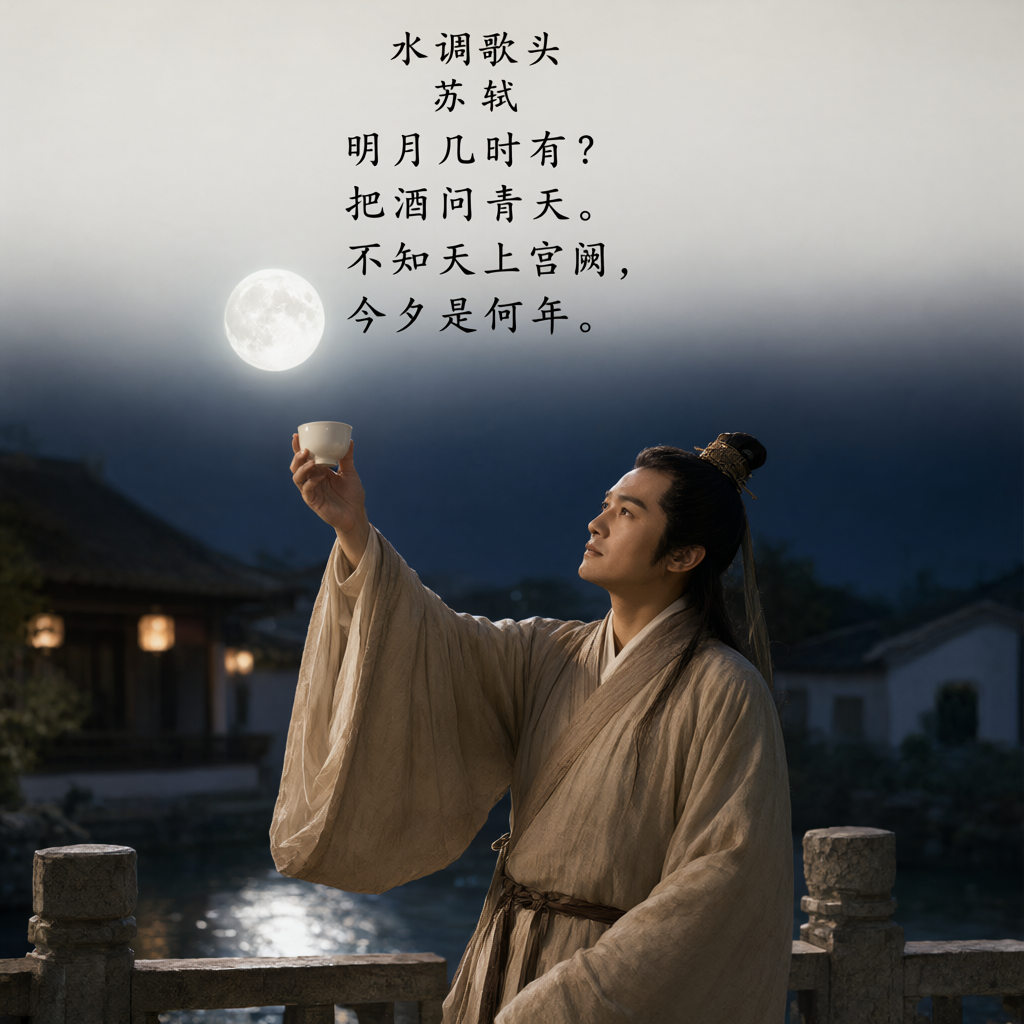
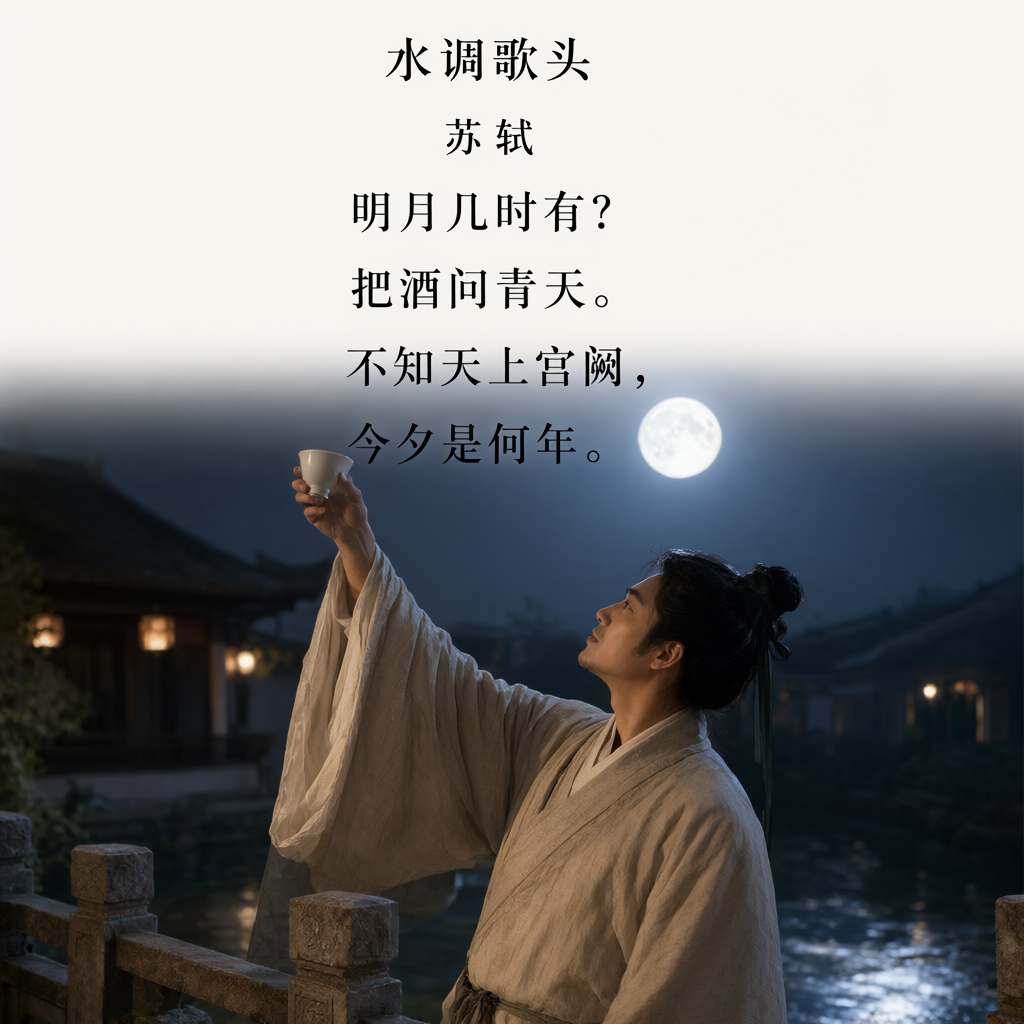
| Moonlit toast | 《水调歌头》 | Chinese | Deep blue moonlit night, the figure raises a cup and looks at the full moon |
| Chinese Snow River | 《江雪》 | Chinese | Snow-covered mountains and a cold river, an old man in a straw cape and hat fishing alone |
| English Snow River | Snow River | English | The same composition as the Chinese Snow River, with the text in English |
| Lakeside daffodils | Daffodils | English | A spring lakeside, the figure walking among daffodils |
Group A gives the text to be written and the scene in full; on top of that, Group B adds line order, font size and text area, and forbids any extra signature. Both groups use the same scene description; the only difference is the text-and-layout passage.
3. The variable: two prompt styles
The difference between the two prompts comes down to one sentence: A says what to write, B also says how to lay it out.
After the original description, Group B adds three sets of requirements: the text area is confined to the pale blank region in roughly the upper third of the image; each line of text is given its line number, font size and centring; and seals, signatures, English or any other words are explicitly forbidden. The corresponding part of Group A is a single sentence: "lay out the following poem title, author and verse in the pale area in the upper part of the image, clearly readable".
4. Result: a dropped letter in the English of Lakeside daffodils
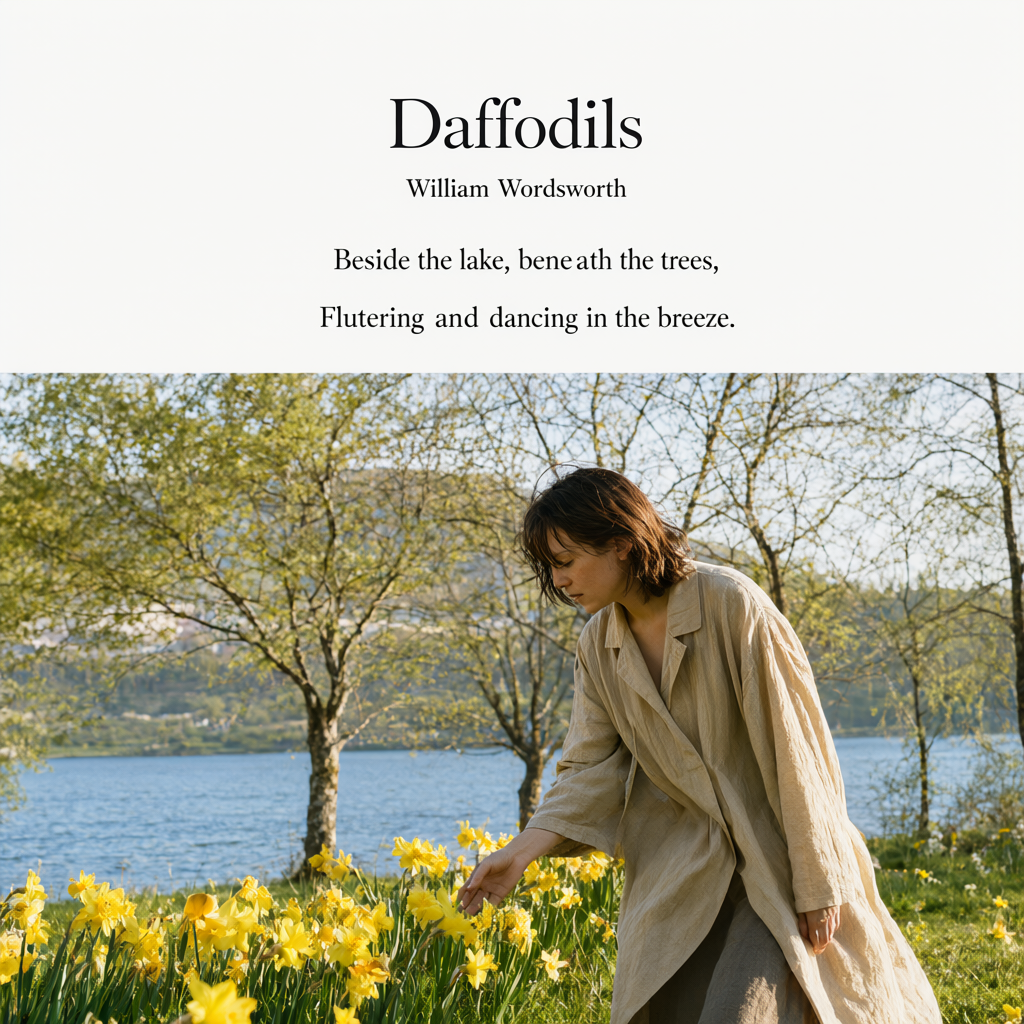
Lakeside daffodils is the only set in this issue for which neither prompt style passed on text.
The image itself is not the problem: the figure, the flowerbed, the lake and the trees are all
there, and the figure's position, pose and lighting match the description. Checking character by
character, the English verse line Fluttering and dancing in the breeze. was written as
Flutering — one t missing.
5. Result: the last character of the signature in the Chinese Snow River
The Chinese Snow River set is given the same 《江雪》, with Group A and Group B on the same seed 42. The two images received different text verdicts: in A the last character of the author's signature cannot be confirmed, while in B "柳宗元" is clearly legible.
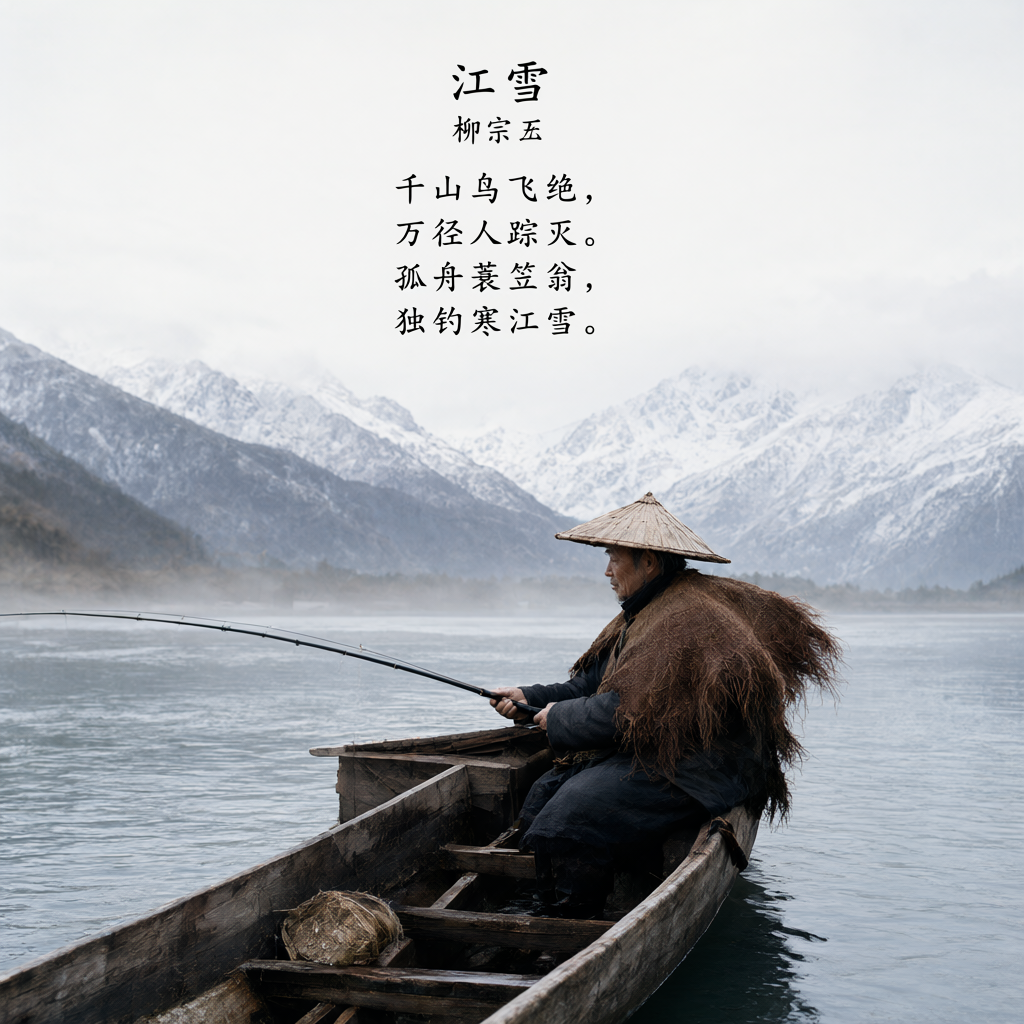
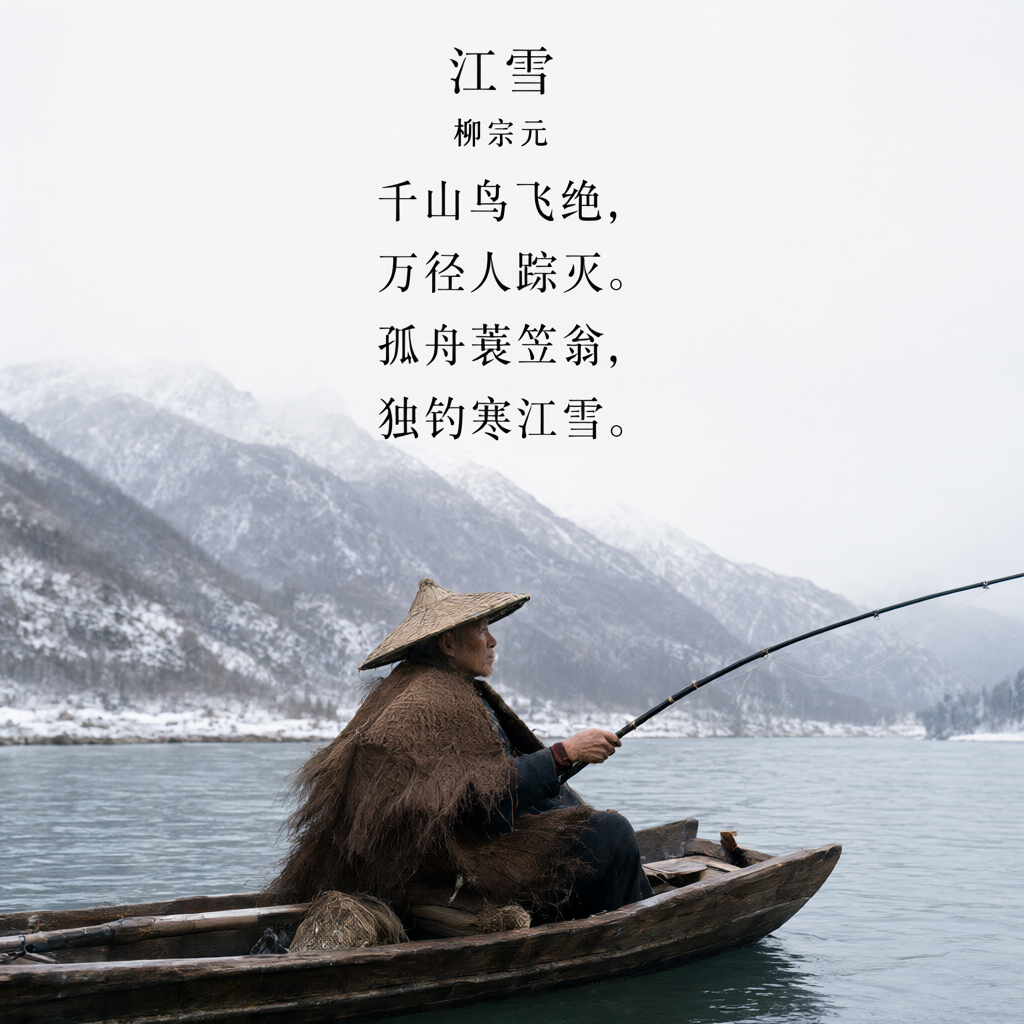
The character-by-character check looks first at the title and the signature, then at each verse line. A comparison of two images on the same seed shows only how this one pair of samples differs; it does not support a conclusion that one style is better — all 16 results are counted in the full table in Section 8.
6. Result: text and layout in Moonlit toast
In the Moonlit toast set, Group B passes on all of the text but fails the shared layout: the last line falls in the darker night sky and is not entirely inside the pale text area in the upper part of the image that the prompt requires. The six text blocks are still legible in themselves, so this was not judged a text error.
| Criterion | Result |
|---|---|
| Text | Pass |
| Scene | Pass |
| Figure | Pass |
| Shared layout | Fail |
This is the clearest case in this issue of correct text and correct layout coming apart: passing the text criterion does not mean that its position on the image also meets the requirement.
7. Result: the Chinese Snow River and the English Snow River
The English Snow River is a set retested after the same 《江雪》 was translated into English by the site itself; apart from the text it shares the composition of the Chinese Snow River. The Group B image on seed 42 passes all four criteria: the title, the signature, and the capitalisation, punctuation and spacing of the two verse lines were all checked, the text sits in the pale sky above, and the boat, the figure and the river surface sit in the middle and lower part.
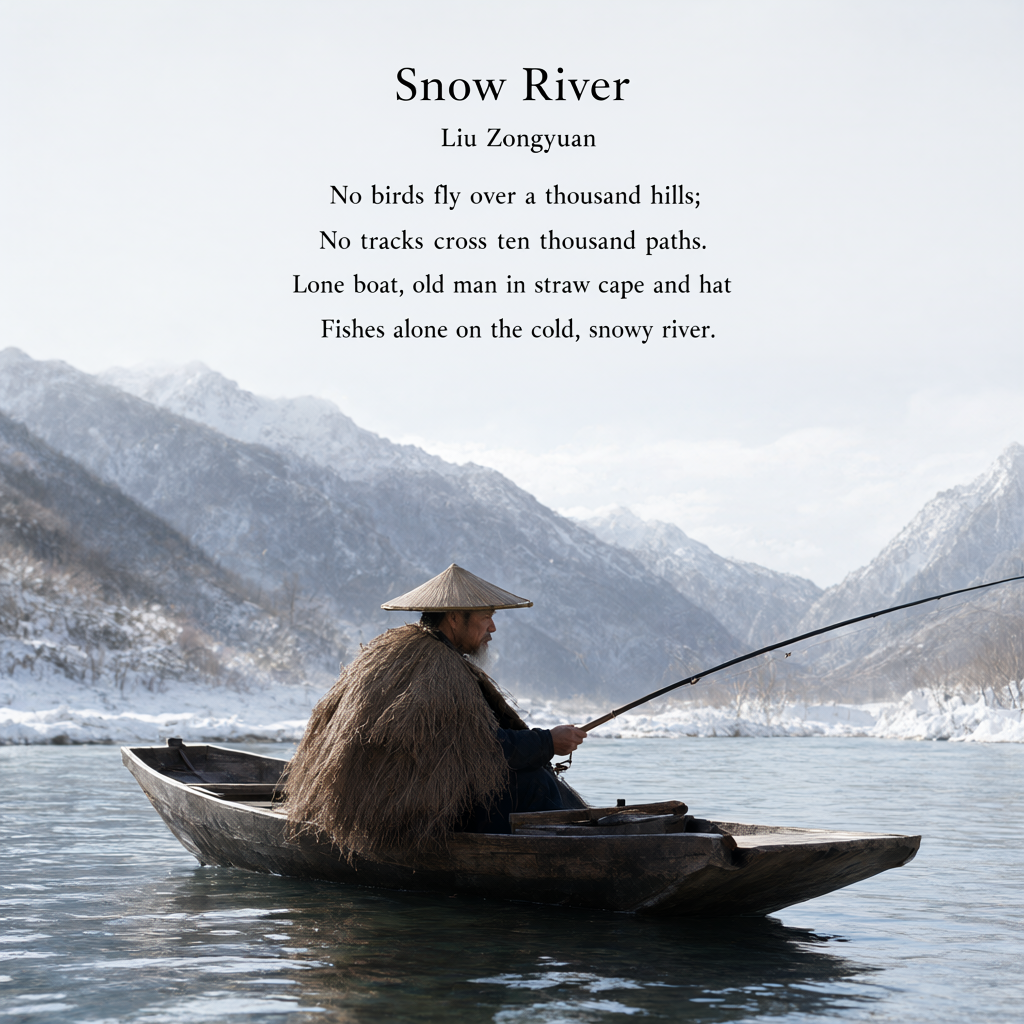
8. All 16 scored results
Four sets of poems, each with two prompt styles and two seeds, 16 images in total, all scored.
| Title | seed | Group A | Group B |
|---|---|---|---|
| Moonlit toast | 42 | Pass QP-R002 |
Pass QP-002 |
| Moonlit toast | 2026 | Pass QP-004 |
Pass QP-003 |
| Chinese Snow River | 42 | Fail QP-006 |
Pass QP-005 |
| Chinese Snow River | 2026 | Fail QP-007 |
Pass QP-008 |
| English Snow River | 42 | Fail QP-009 |
Pass QP-010 |
| English Snow River | 2026 | Fail QP-012 |
Pass QP-011 |
| Lakeside daffodils | 42 | Fail QP-014 |
Fail QP-013 |
| Lakeside daffodils | 2026 | Fail QP-015 |
Fail QP-016 |
Text pass rate: Group A 2/8, Group B 6/8; scene and figure are 8/8 in both groups; shared layout Group A 6/8, Group B 7/8.
Group B's text pass rate is higher, but what changed between the two groups is a whole set of description (line order, font size, area and the ban on signatures all changed together), so it cannot be attributed to any single one of them, and it does not guarantee success every time — Lakeside daffodils failed on both styles. The other two runs are counted for performance only and are not in this table.
9. The cost: time per image and system memory
On this machine, from starting a new process to saving and verifying the original image, three observations: 222.97 s, 232.99 s, 232.49 s, mean 229.5 s, sample standard deviation 5.64 s; the workflow itself averaged 206.7 s.
| Observation | New process → save and verify original image (s) |
|---|---|
QP-002 |
222.97 |
QP-P001 |
232.99 |
QP-P002 |
232.49 |
| Mean (n = 3) | 229.5 |
On memory: across the three sampling runs, the GPU and WSL were sampled every 0.5 s and the whole Windows machine every 1 s, giving these peak ranges:
| Scope | Peak |
|---|---|
| GPU VRAM (whole card) | 4.87 GiB |
| WSL environment memory | 13.73–13.81 GiB |
| Whole Windows machine (including other activity) | 37.19–37.63 GiB |
This machine is a 6 GB GPU plus 64 GB of system memory. The model runs INT8 generative weights, with CLIP, the text cache and the VAE on the CPU, loaded through system memory. Being able to run at all carries that memory cost.
The three scopes cannot be added together: VRAM, the WSL environment and the whole Windows machine measure the same activity at different boundaries. The sampling interval can miss short peaks. New-process timing includes front-end preparation, and workflow timing includes submission and history polling; neither is pure GPU time. n = 3 is enough to indicate an order of magnitude, not to claim stable performance.
10. The workflow that actually ran, and the generation process
Generation uses native ComfyUI, with no wrapper and no cloud service. The workflow itself is short: the prompt goes into text encoding, then sampling, then decoding and saving.
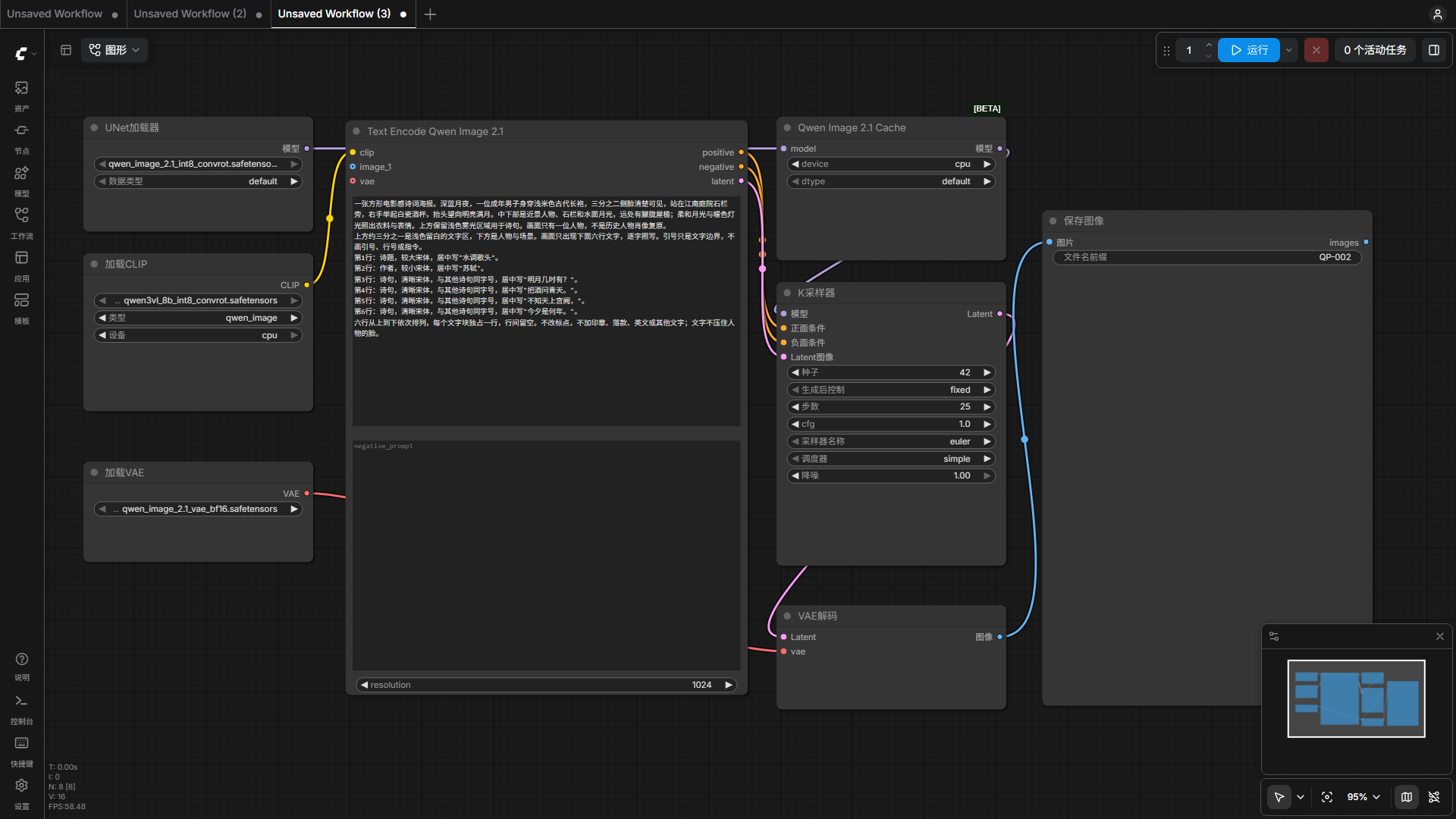
TextEncodeQwenImage21 running on the CPU, sampling is 25 steps of euler at CFG 1, and decoding and saving are the VAE running on the CPU followed by SaveImage.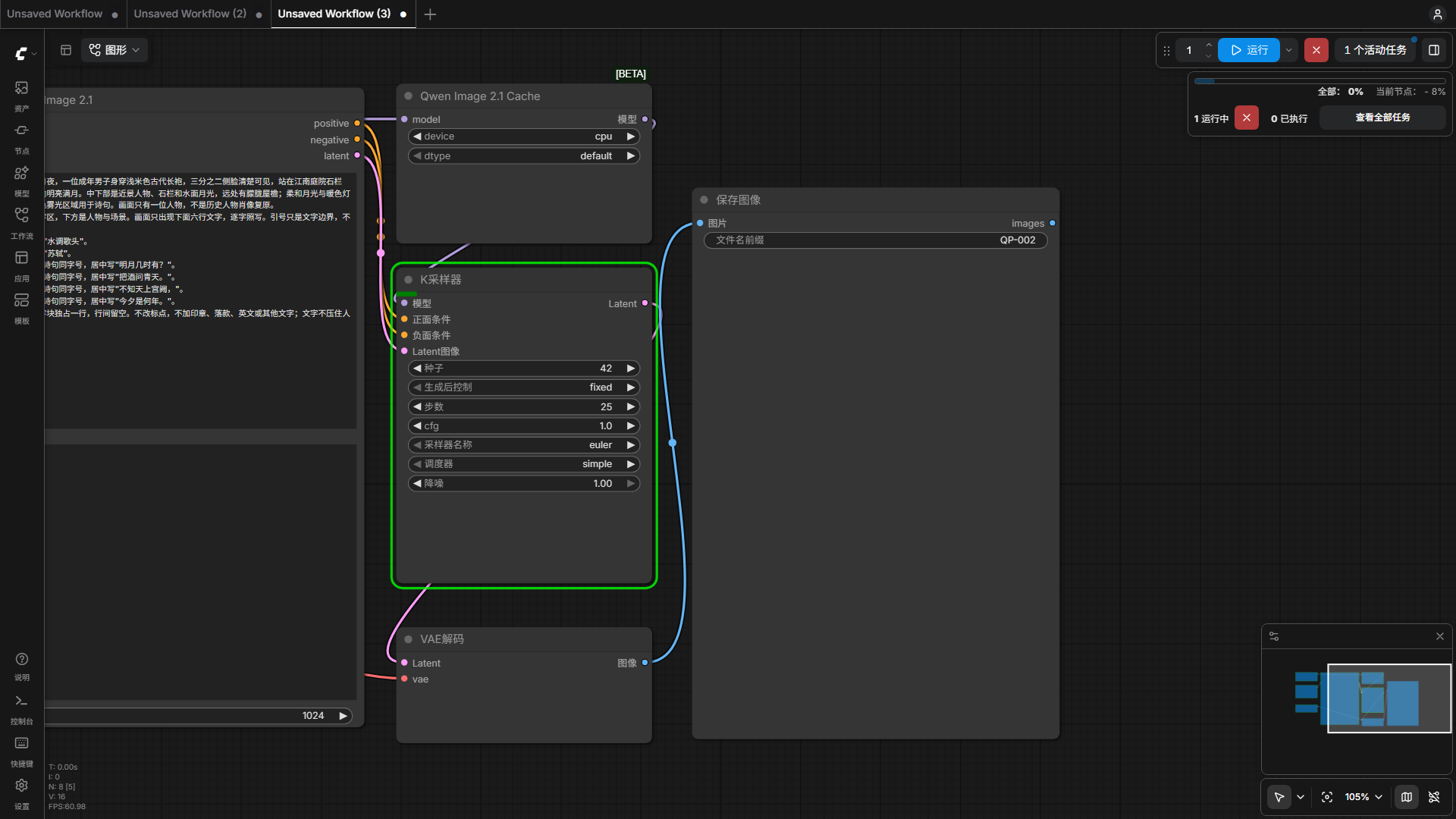
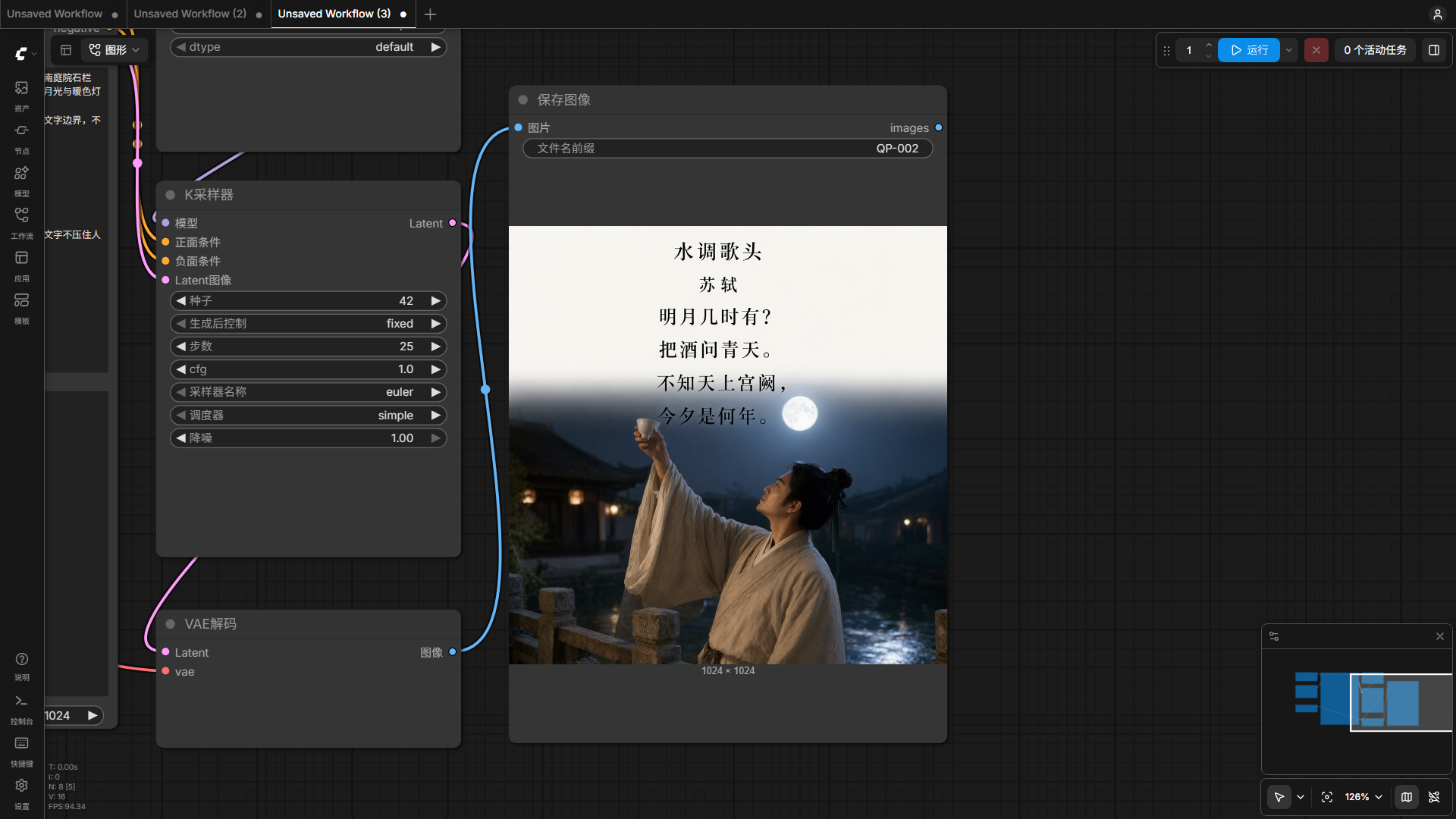
SaveImage node. From submission to result, the wait for a whole image is about 223.0 s. The importable JSON workflow and a continuous screen recording are in the asset index.11. Measurement method and how the figures are defined
Text pass requires the title, the signature, the body text and the punctuation to be fully correct, checked character by character; one wrong character means a fail. Scene, Figure and Shared layout are three other criteria, each judged independently and not converted into one another.
The verdict records for the scored results are kept under reviews/ in the experiment directory,
one JSON per image, in which text_success, scene, portrait and layout_shared are
booleans. The pass counts for the 16 images in this issue are counted directly from these
records, not filled in afterwards by eye from the pictures.
There are two timing scopes: new-process timing starts when the new process is launched, includes front-end preparation, and ends when the original image is saved and verified; workflow timing covers only submission and history polling. The two cannot be mixed. Memory sampling is periodic and can miss short peaks, so the ranges serve only as an order-of-magnitude reference.
Two runs in this experiment failed before submission (QP-001, an interface failure, and QP-R001, a transfer failure); both are excluded from the model and text denominator under the pre-registered rule and are not counted in the pass rate. Their replacement is QP-R002 (see Section 3); the Group A seed 42 entry in the scored-results table uses the replacement run's result.
12. Conclusion
On a laptop GPU with 6 GB of VRAM, Qwen-Image 2.1 can put the verse, the scene and the figure into one image as the prompt requires, and no criterion in the picture category recorded a failure: scene 16/16, figure 16/16. What limits it is text.
8 of the 16 images got the text completely right. Once line order, font size, text area and the
ban on signatures were all written out together, Group B raised the text pass rate from 2/8 to
6/8, but what changed is a whole set of description; it cannot be attributed to a single item,
and it is not effective every time — neither style for Lakeside daffodils wrote Fluttering
correctly.
Correct text and correct layout are two different things. Group B for Moonlit toast passes all of the text, yet the last line falls into the darker night sky and the shared layout is judged a fail. To get a usable image, the output still has to be checked character by character afterwards.
On cost: about 4 minutes per image on this machine, plus 13.73–13.81 GiB of WSL environment memory. For everyday attempts this time is acceptable; for batch generation, both the time and the memory have to be worked out first.
13. Appendix: the complete prompts that actually ran
This section reproduces the complete prompt text actually submitted for the four sets of poems in this issue, with no sentences removed, no quotes changed, and the original line breaks preserved. Soft wrapping on screen does not change the input characters.
13.1 Moonlit toast · B / seed 42 (corresponding to QP-002)
Original Chinese prompt as submitted:
一张方形电影感诗词海报。深蓝月夜,一位成年男子身穿浅米色古代长袍,三分之二侧脸清楚可见,站在江南庭院石栏旁,右手举起白瓷酒杯,抬头望向明亮满月。中下部是近景人物、石栏和水面月光,远处有朦胧屋檐;柔和月光与暖色灯光照出衣料与表情。上方保留浅色雾光区域用于诗句。画面只有一位人物,不是历史人物肖像复原。 上方约三分之一是浅色留白的文字区,下方是人物与场景。画面只出现下面六行文字,逐字照写。引号只是文字边界,不画引号、行号或指令。 第1行:诗题,较大宋体,居中写"水调歌头"。 第2行:作者,较小宋体,居中写"苏轼"。 第3行:诗句,清晰宋体,与其他诗句同字号,居中写"明月几时有?"。 第4行:诗句,清晰宋体,与其他诗句同字号,居中写"把酒问青天。"。 第5行:诗句,清晰宋体,与其他诗句同字号,居中写"不知天上宫阙,"。 第6行:诗句,清晰宋体,与其他诗句同字号,居中写"今夕是何年。"。 六行从上到下依次排列,每个文字块独占一行,行间留空。不改标点,不加印章、落款、英文或其他文字;文字不压住人物的脸。
13.2 Chinese Snow River · B / seed 42 (corresponding to QP-005)
Original Chinese prompt as submitted:
一张方形电影感诗词海报。寂静的雪山寒江,一位戴竹笠、披粗麻蓑衣的老年男子独坐木船垂钓,侧脸和握住钓竿的手清楚可见。木船与人物在中下部近景,后方是覆雪山峰、冷灰色江水和薄雾,没有飞鸟、其他人或脚印。柔和冷色天光映在雪与水面,人物保持可辨认,不缩成远处黑点。上方是浅色雾天空,留给诗句。画面只有一位人物。 上方约三分之一是浅色留白的文字区,下方是人物与场景。画面只出现下面六行文字,逐字照写。引号只是文字边界,不画引号、行号或指令。 第1行:诗题,较大宋体,居中写"江雪"。 第2行:作者,较小宋体,居中写"柳宗元"。 第3行:诗句,清晰宋体,与其他诗句同字号,居中写"千山鸟飞绝,"。 第4行:诗句,清晰宋体,与其他诗句同字号,居中写"万径人踪灭。"。 第5行:诗句,清晰宋体,与其他诗句同字号,居中写"孤舟蓑笠翁,"。 第6行:诗句,清晰宋体,与其他诗句同字号,居中写"独钓寒江雪。"。 六行从上到下依次排列,每个文字块独占一行,行间留空。不改标点,不加印章、落款、英文或其他文字;文字不压住人物的脸。
13.3 Chinese Snow River · A / seed 42 (corresponding to QP-006)
Original Chinese prompt as submitted:
一张方形电影感诗词海报。寂静的雪山寒江,一位戴竹笠、披粗麻蓑衣的老年男子独坐木船垂钓,侧脸和握住钓竿的手清楚可见。木船与人物在中下部近景,后方是覆雪山峰、冷灰色江水和薄雾,没有飞鸟、其他人或脚印。柔和冷色天光映在雪与水面,人物保持可辨认,不缩成远处黑点。上方是浅色雾天空,留给诗句。画面只有一位人物。 把以下诗题、作者和诗句排在画面上方的浅色区域,清楚可读: 江雪 柳宗元 千山鸟飞绝, 万径人踪灭。 孤舟蓑笠翁, 独钓寒江雪。
13.4 English Snow River · B / seed 42 (corresponding to QP-010)
A square cinematic poetry poster shows a silent snowy mountain river. One elderly man in a straw cape and bamboo conical hat sits alone in a wooden fishing boat, his profile and hand holding the fishing rod clearly visible. The boat and man occupy the middle and lower foreground, with snow-covered peaks, cold grey water and mist behind them. There are no birds, other people or footprints. Soft cool daylight reflects from snow and water; the fisherman remains a visible person rather than a distant dot. Pale misty sky across the top leaves room for the verse. The pale upper third holds the text; the person and scenery occupy the lower two thirds. Only the following text appears, copied character for character. Quotes mark text boundaries and are not printed. Line 1: centered large serif title reads "Snow River". Line 2: centered smaller serif author reads "Liu Zongyuan". Line 3: centered legible serif verse, same size as the other verse lines reads "No birds fly over a thousand hills;". Line 4: centered legible serif verse, same size as the other verse lines reads "No tracks cross ten thousand paths.". Line 5: centered legible serif verse, same size as the other verse lines reads "Lone boat, old man in straw cape and hat". Line 6: centered legible serif verse, same size as the other verse lines reads "Fishes alone on the cold, snowy river.". Keep each text block on its own line in the stated order, with clear spacing. Preserve capitalization, spaces and punctuation. Add no seals, signatures, Chinese, captions or other words. Keep text clear of the person's face.
13.5 Lakeside daffodils · B / seed 42 (corresponding to QP-013)
A square cinematic poetry poster shows a bright spring lakeside. One adult traveller with shoulder-length brown hair and a light linen coat walks among yellow daffodils beside the lake, beneath fresh green trees. The person is prominent in the lower right, looking at the flowers with a relaxed expression; the coat and flowers move gently in the breeze. Warm soft sunlight lights the face and petals, with blue water and hills in the distance. The pale upper sky leaves room for the verse. There is only one person; this is an imagined poetic scene, not a portrait of the author. The pale upper third holds the text; the person and scenery occupy the lower two thirds. Only the following text appears, copied character for character. Quotes mark text boundaries and are not printed. Line 1: centered large serif title reads "Daffodils". Line 2: centered smaller serif author reads "William Wordsworth". Line 3: centered legible serif verse, same size as the other verse lines reads "Beside the lake, beneath the trees,". Line 4: centered legible serif verse, same size as the other verse lines reads "Fluttering and dancing in the breeze.". Keep each text block on its own line in the stated order, with clear spacing. Preserve capitalization, spaces and punctuation. Add no seals, signatures, Chinese, captions or other words. Keep text clear of the person's face.